BLOG
The Modern Localization Workflow
January 28, 2026
Localization today is no longer a linear translate → review → deliver process. It is a continuous, system-driven workflow that blends AI, automation, human expertise, and metrics from the start. When localization is treated as a late-stage task, quality suffers and costs rise.
This post explains how a modern localization workflow is done today, based on current best practices used by LSPs, vendors, and enterprise localization teams.
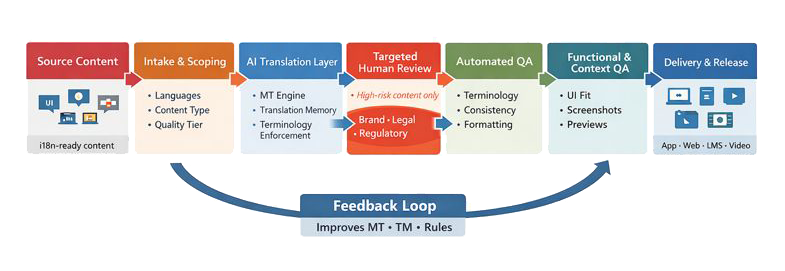
Content Is Prepared Before Translation Starts
Modern localization starts upstream.
Before a single word is translated, teams focus on:
- Internationalization (i18n), including Unicode support, locale-aware formatting, and expandable UI
- Clean content structure with reusable segments and minimal inline formatting
- High-quality source content that is clear, concise, and unambiguous
Preventing localization issues early is far more efficient than fixing them later.
Centralized Intake via a TMS (or Equivalent)
All localization work flows through a central system such as a Translation Management System, a Git-based localization platform, or a custom pipeline connected to CI/CD.
At intake, teams define:
- Target languages and locales
- Content type, such as UI, documentation, marketing, or multimedia
- Turnaround expectations
- Quality tier, ranging from AI-only to full human review
This step determines how automation and human effort are applied throughout the workflow.
AI Is the Default, Not the Exception
AI now sits at the core of most localization workflows.
Common components include:
- Neural Machine Translation as the baseline
- Translation Memory reuse to reduce effort and cost
- Terminology enforcement during translation
- Automated pre-QA to catch issues early
The shift is not about replacing humans. It is about using humans where judgment and context matter most.
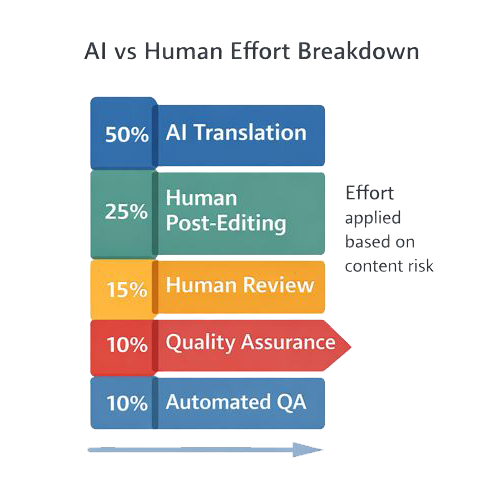
Human Review Is Targeted, Not Universal
Modern workflows avoid reviewing everything manually.
Human effort is applied selectively based on:
- Content visibility
- Legal or regulatory risk
- Brand sensitivity
- AI confidence levels
- Historical quality data
This approach maintains quality while keeping localization scalable and cost-effective.
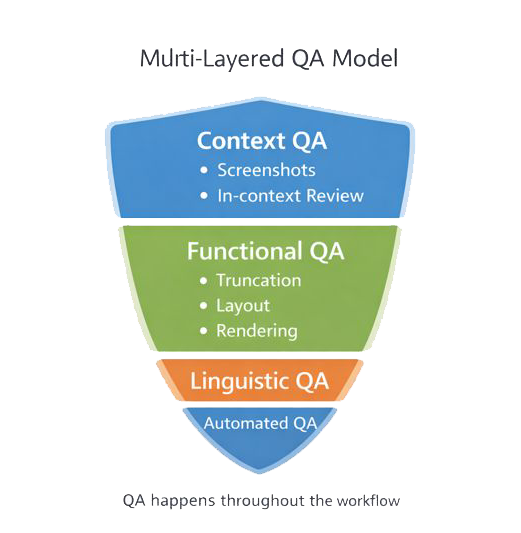
QA Is Multi-Layered and Partly Automated
Quality assurance is no longer a single step at the end of the process.
Modern localization workflows include multiple QA layers:
- Automated QA for terminology, consistency, formatting, and tags
- Linguistic QA for accuracy, fluency, and tone
- Functional QA for truncation, layout, and rendering issues
- Context QA using screenshots, previews, or in-context review
QA is continuous and distributed across the workflow, not concentrated at delivery.
Metrics Drive Decisions
Modern localization relies on measurable data rather than intuition.
Teams track:
- Productivity by content type
- Runtime-based calculations for audio and video
- QA effort by word or by minute
- Automation coverage across projects
When planning work or estimating capacity, tools like l10n-estimator.com help ground decisions in realistic production assumptions. Metrics support planning, not guarantees.
Delivery Is Continuous
Localization does not stop at release.
Modern workflows support:
- Incremental updates
- Continuous releases
- Rolling language additions
- Post-release fixes without restarting the full cycle
This approach is essential for SaaS platforms, mobile apps, help centers, and multimedia content.
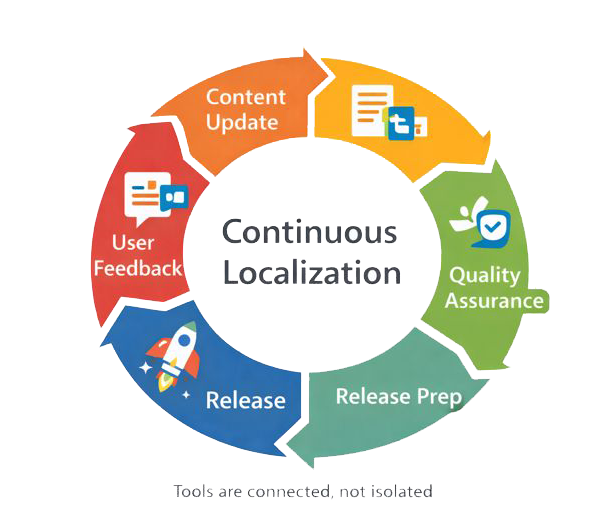
Feedback Loops Improve Everything
Strong localization programs collect feedback continuously from:
- Linguists
- Vendors
- Project managers
- End users
That feedback improves:
- Machine Translation engines
- Terminology and style guides
- Automation rules
- Estimation accuracy
Localization quality improves over time when feedback is built into the workflow.
Final Thoughts
A modern localization workflow is:
- Automated where possible
- Human where it counts
- Measured, not guessed
- Continuous, not linear
If localization still relies on inboxes and spreadsheets, it is time to rethink the process.
For readers interested in foundational localization concepts, A Practical Guide to Localization by Bert Esselink remains a useful reference.